
Recognizing the importance of early childhood education, the International Baccalaureate (IB) has developed the PYP for the Early Years, a programme that focuses specifically on the developmental needs, interests, and capabilities of children aged 3 to 6 years.
Key Principles of the PYP in the Early Years
The PYP for Early Years education focuses on fostering a positive attitude towards learning through experiences that promote exploration and discovery. Students are encouraged to participate actively in the learning process through hands-on activities and free play, which connect learning with their everyday lives.
The programme respects and builds upon students' prior knowledge and experiences, giving them the opportunity to ask questions, inquire, discover, and develop their creativity and imagination.
The Role of the Teacher and Programme Implementation
Teachers, as guides and companions in students' learning journey, create a safe and supportive environment where curiosity and collaboration are nurtured on a daily basis.
The programme is based on four key features, which are harmoniously interconnected in order to enhance the learning process:
Play: Play is a fundamental tool for learning. Children learn through action, exploration, and interaction, while developing agency and self-confidence.
Learning Spaces: Learning environments are safe, engaging, and intentionally organized to stimulate curiosity, creativity, and collaboration.
Symbolic Exploration and Expression: Language, mathematics, and the arts are all systems of symbols. Through play and their experiences, children learn to use these "codes" to communicate, solve problems, and understand the world around them.
Relationships: Strong relationships with families, peers, and teachers support children's sense of belonging and provide the foundation for learning and holistic development.
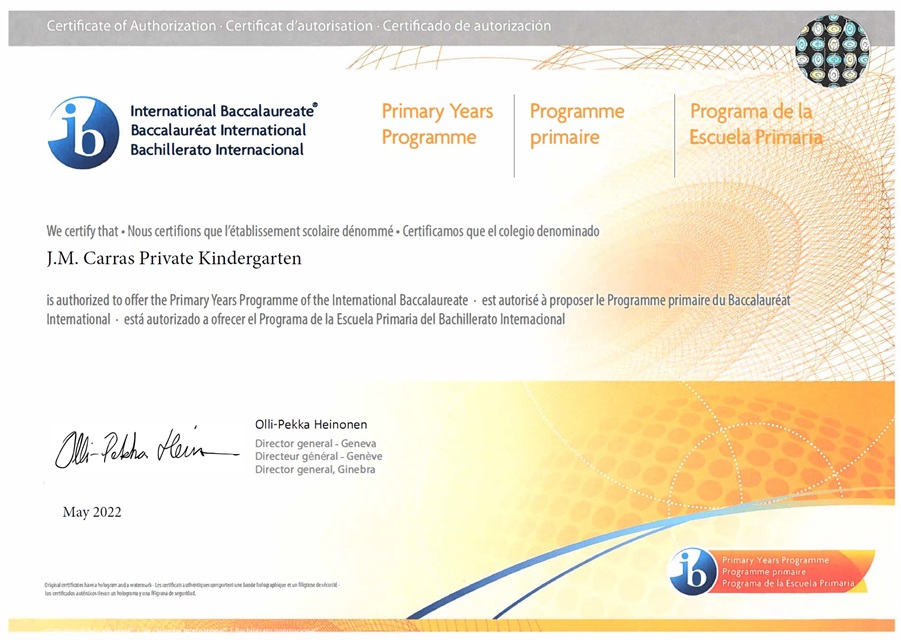
J.M Carras Kindergarten was officially authorized as an IB World School offering the Primary Years Programme (PYP) in May 2022. To ensure the highest quality implementation of the PYP, all members of our learning community engage in continuous professional development through workshops and training programs in both Greece and abroad. In accordance with IB requirements, every IB World School undergoes a formal Programme Evaluation every five years to review, enhance, and ensure the quality of programme implementation.
As an IB World School, our kindergarten is part of a global community of schools committed to developing knowledgeable, caring, and internationally-minded learners who share common values, embrace cultural diversity, and demonstrate respect for others. Our IB authorization reflects the high standards of education that define our school and reaffirms our ongoing commitment to educational excellence, as expressed in our Mission Statement.
The Programme of Inquiry in the PYP Early Years
At the kindergarten, teachers implement the Programme of Inquiry, which guides children's learning throughout the school year. It is based on six transdisciplinary themes, which the PYP has identified as themes of global significance and relevance. These themes help children explore the world from different perspectives and develop a holistic and meaningful understanding of their environment and society.
The six transdisciplinary themes are:
Who we are: An inquiry into identity as individuals and as part of a collective through:
- physical, emotional, social and spiritual health and well-being
- relationships and belonging
- learning and growing
Where we are in place and time: An inquiry into histories and orientation in place, space and time through:
- periods, events and artefacts
- communities, heritage, culture and environment
- natural and human drivers of movement, adaptation, and transformation
How we express ourselves: An inquiry into the diversity of voice, perspectives, and expression through:
- inspiration, imagination, creativity
- personal, social and cultural modes and practices of communication
- intentions, perceptions, interpretations and responses
How the world works: An inquiry into understandings of the world and phenomena through:
- patterns, cycles, systems
- diverse practices, methods and tools
- discovery, design, innovation: possibilities and impacts
How we organize ourselves: An inquiry into systems, structures and networks through:
- interactions within and between social and ecological systems
- approaches to livelihoods and trade practices: intended and unintended consequences
- representation, collaboration and decision-making
Sharing the planet: An inquiry into the interdependence of human and natural worlds through:
- rights, responsibilities and dignity of all
- pathways to just, peaceful and reimagined futures
- nature, complexity, coexistence and wisdom
In the PYP Early Years, the transdisciplinary themes are organized into four Units of Inquiry at each year level. These Units provide the framework for learning throughout the school year, encompassing knowledge (such as language and mathematics), the Approaches to Learning (ATL) Skills, and the Learner Profile attributes that we seek to cultivate in our students.
Guided by the children's interests, needs, and prior knowledge, classroom teachers, in collaboration with specialist teachers, design developmentally appropriate learning experiences in both Greek and English. The aim is for students to harness the power of play to construct meaning and develop conceptual understandings by making connections between their experiences, new knowledge, and inquiry.
The Structure of a Unit of Inquiry
Each Unit of Inquiry is built around a Central Idea, which represents the enduring understanding that children are expected to develop by the end of the unit. The Central Idea provides the context and overall direction for learning and inquiry.
The Lines of Inquiry identify the key aspects through which the Central Idea is explored and are supported by specified concepts that deepen students' conceptual understanding. Teachers facilitate the inquiry process by posing purposeful questions and building on the children's own questions, guiding them towards deeper understanding. Through this process, children develop knowledge, strengthen their Approaches to Learning (ATL) Skills, and cultivate the attributes of the IB Learner Profile.
The inquiry process is active and student-centered, encouraging children to develop skills such as observation, thinking, collaboration, and communication, while also fostering dispositions such as responsibility, respect, and empathy.
Furthermore, through these experiences, students are not limited to acquiring knowledge alone, but are inspired to take small Actions in their everyday lives. For example, they may suggest a rule to promote fairer play with their friends, organize a toy collection initiative together with their parents for families in need, or create posters for their classroom or school promoting cooperation and respect. In this way, learning is connected to action and becomes a way of life.