
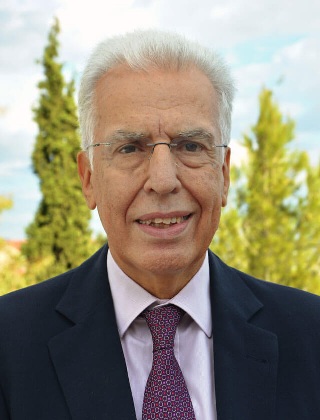
Nikiforos Diamantouros
Professor Emeritus at University of Athens
Vice President of the Academy of Athens
Nikiforos Diamantouros graduated from Athens College in 1961. He holds a PhD from the University of Columbia (1972), is Professor Emeritus of Political Science at the University of Athens and since 2012 a Visiting Professor at the College of Europe (Bruges). From 2003 to 2013 he was the Ombudsman of the European Union, and from 1998 to 2003 the first National Ombudsman of Greece as well as Director and Board Chairman of the Greek National Center for Social Research (EKKE). In 2014 he was elected member of the Academy of Athens where he currently serves as Vice President, and in 2016 he was appointed member of the Advisory Committee to the New Pact for Europe, which is chaired by Herman van Rompuy. He was awarded an honorary doctorate from Panteion University in 2015 and by the American College of Greece in 2011.
He has been decorated by the Presidents of France (Chevalier de la Légion d’ Honneur 2014), of Poland (Golden Cross of Merit 2010), and of Greece (Grand Commander of the Order of the Phoenix 2004). His most recent publications focus on democracy, the rule of law, the institution of ombudsman, public administration, and the relationship between politics and culture. Between 1978 and 1983, he served as assistant to the President of Athens College and Director of the Development Office.
Abstract:
«Πολίτας Τρέφον»: A renewal of the commitment of Athens College to Education
My goal in this short intervention is to highlight the deeper and, in many ways, “hidden” dimension of the motto «Άνδρας Τρέφον» in the process of defining the vision, goals and ideals informing the identity of the newly, in 1925, established school called Athens College.
Borrowing from Walter Bagehot, the famous 19th century editor of The Economist, I will use the seminal distinction between what he called the “dignified” and “efficient” elements of the English Constitution, in the celebrated work by the same name, to point to the formal and informal arrangements, which, in his eyes, constituted the salient characteristics of the unwritten constitution of his country, then at the height of its power.
I will argue that the motto chosen for the school reflected a similar distinction and logic, which sought to distinguish between the formal or “overt” curriculum, which concerned academic learning and academic excellence, and the “hidden” curriculum, whose purpose was the moral education of the students and their preparation to become responsible citizens capable of adequately serving their country.
In this sense, the motto should be understood as a distinct contribution of the then newly established school to Greek education and its current “return” in a prominent position in the school’s emblem, on the occasion of this centennial year, as a most welcome, and hopefully auspicious, development, which could serve as an element informing the Athens College vision for the coming hundred years.